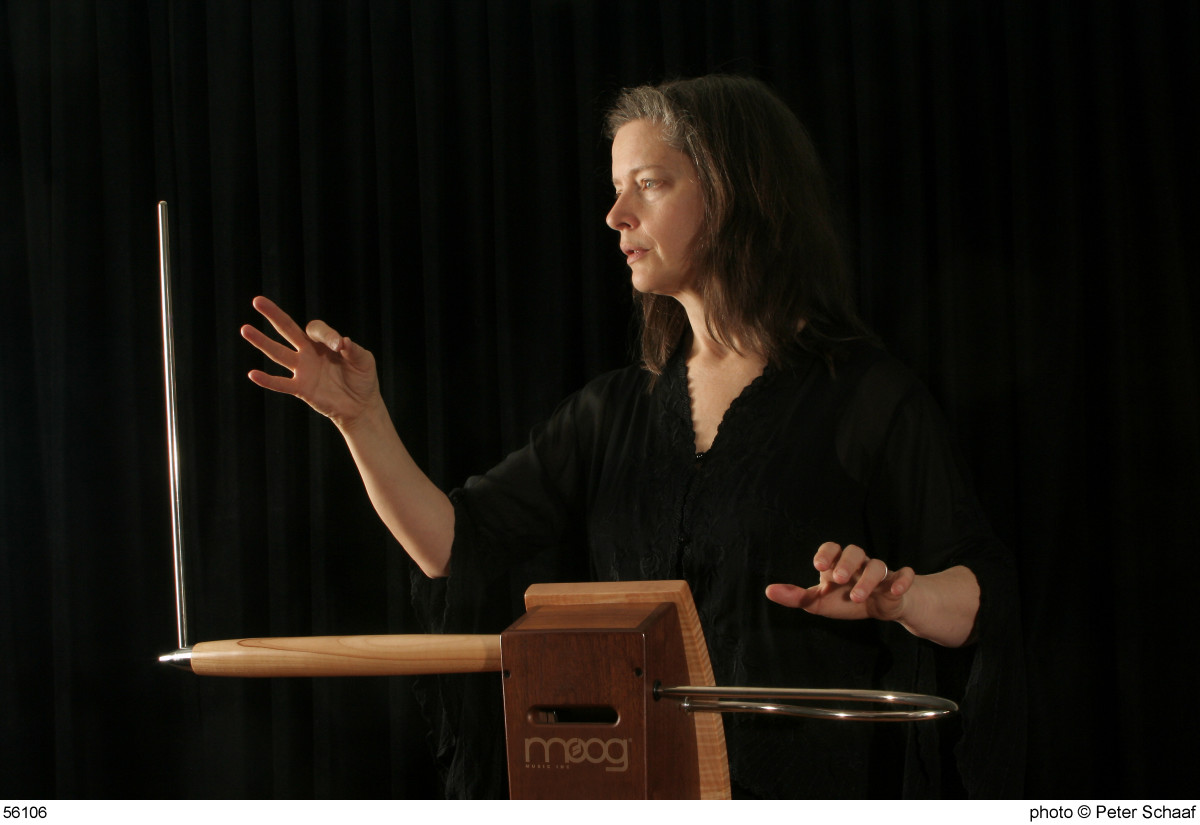
Elizabeth Brown has combined a composing career with a diverse performing life, playing shakuhachi, flute, and theremin in a wide variety of musical circles around the world. Her chamber music, shaped by this unique group of instruments and experiences, has been called luminous, dreamlike and hallucinatory.
Brown’s music has been heard in Japan, Russia, Colombia, Australia, South Africa, Korea, and Vietnam as well as across the US and Europe. A Guggenheim Fellowship recipient and Juilliard graduate, she has received grants, awards and commissions from Orpheus, St. Luke’s Chamber Ensemble, Newband, The Bridgehampton Chamber Music Festival, the Barlow Foundation, the Asian Cultural Council, the Japan/US Friendship Commission, Music from Japan, Bravo! Vail Valley Music Festival, the Cary Trust, Sylvan Winds, Castle of Our Skins, NewMusicUSA, Copland Fund, NYSCA, and NYFA, among many others. She has two solo albums: Elizabeth Brown: Mirage (New World) and Blue Minor: Chamber Music by Elizabeth Brown (Albany), and her music is also available on CRI, Innova, and Music and Arts. She has been Artist-in-Residence at the Hanoi National Conservatory and in Grand Canyon National Park, and a fellow at the Rockefeller Foundation’s Bellagio Center in Italy and at the MacDowell Colony.
As an orchestral musician, Brown has performed as thereminist with the Boston Symphony, Minnesota Orchestra, American Symphony, and American Composers Orchestra; and has played flute with Orpheus, Philharmonia Virtuosi, New York City Ballet Orchestra, American Symphony and many other NYC orchestras. Her performing life now concentrates on shakuhachi.
Brown began studying shakuhachi in 1982 and its music has been a major influence on her musical language. She is celebrated both here and in Japan for her compositions and performances combining eastern and western sensibilities. Since winning grand prize in the Makino Yutaka Composition Competition (for Japanese traditional instrument orchestra) as well as a prize in the Senzoku Gakuen Shakuhachi Composition Competition, her music has been performed in Japan by Pro Musica Nipponia, Reigakusha, and Orchestra Asia. Music from Japan presented her in recital with nohkan/shinobue artist Kohei Nishikawa in New York City and at the Smithsonian in Washington, D.C. With the late ichigenkin artist Issui Minegishi, she toured Japan and the U.S. from 2014-2022 with Trio Getsuro, often performing Brown’s composition Aki Meguri Kite “autumn comes round again”, a setting of tanka written by survivors of the 2011 earthquake and tsunami.
Brown was invited to perform at World Shakuhachi Festivals in Sydney, Australia, Kyoto, London, and New York City. Shakuhachi players from six different continents performed her composition Tall Grasses on the gala opening night concert of World Shakuhachi Festival 2025 in Texas. Recent shakuhachi commissions include both a beginner’s piece for the European Shakuhachi Society and an advanced piece for the World Shakuhachi Festival 2025 performer’s competition. She has been Artist-in-Residence in the Grand Canyon, Acadia National Park, and Isle Royale National Park, working on a series of solo shakuhachi pieces inspired by particular places in nature. With Ralph Samuelson, she co-directs the Hudson Valley Shakuhachi Choir, which performs annually at Brooklyn Botanic Gardens’ Hanami Nights, as well as in Innisfree Garden in Millbrook, NY as part of the Gardens for Peace program created and coordinated by the North American Japanese Garden Association in honor of the United Nations International Day of Peace.
Other notable pieces include Arcana, for flute and recorded sound; Brown’s chamber opera Rural Electrification, for theremin, voice, and recorded sound; ongoing collaborations with artist Lothar Osterburg such as Piranesi, for theremin, string quartet, and video, and A Bookmobile for Dreamers, a forty-minute performance for theremin, recorded sound, and video; the installation Collected Visions, a collaboration with photographer Lorie Novak, which has been presented by the International Center of Photography in NYC, the Smithsonian Institution’s National African American Museum Project, and the Center for Creative Photography in Tucson; Delirium, Archipelago, and Seahorse, all featuring the original microtonal instruments of American composer/inventor Harry Partch; and numerous pieces for the Momenta Quartet, with whom she has an ongoing relationship. Her flute music is performed worldwide.
Brown was born in 1953 in Camden, Alabama, where she grew up on an agricultural research station. After receiving a Master’s degree in flute performance from The Juilliard School in 1977, she started composing in the late 1970’s. Brown has taught shakuhachi at Columbia University and Bard College, and taught theremin at Bard as well. She is married to visual artist Lothar Osterburg.
“…cool, sustained architecture…a suspension of recollected memories.” — Los Angeles Times
“…otherworldly…passionately lyric…tenaciously melodic…” — New York Times
“…sounds both innocently sweet and foreboding…” — Houston Post
“…gently spellbinding…” — Village Voice
“…heartrending…” — New York Native